Showing posts with label literature. Show all posts

Wednesday, 27 November 2013

Book Review: Tweak3nd by O.R.N.

Consider this neat little scene in the sort-of prologue: the narrator is in the bathroom, checking herself from every conceivable angle only to find that she cannot perceive her reflection. This event serves dual roles. First, it illustrates the loss of identity that these characters, this disillusioned slice of a generation, inevitably experience. Their constant and gratuitous exploitation of drugs and alcohol, not only numbs and alters a pervading reality of bland meaningless existence that they desperately try to escape from, but also numbs them from any grip on the meaning of Self. They lose themselves, and further their substance abuse to flee from that too, entrenching themselves in an uncertain ouroboros, spiraling towards despair. Second, the metaphor of the missing reflection illustrates the status of the narrator. She is a placeholder for us. We see through her eyes, into her world, with or without her prejudices. She plays no significant role here, despite an amusing, yet misleading opening chapter.

These characters are quite infuriating to think about, with their copious intake of alcohol, toxic nihilism, and extreme ways of avoiding their purposeless lives. It’s just as disappointing to realize that these people exist, that their lives, while exaggerated, are inevitably real. O.R.N. provides a mirror for us to examine a few days of their amoral lives and see aspects of our own reflected back. This is unromanticized reality, complete with Facebook statuses, BBMs, and tweets.

O.R.N. maintains a steady dubstep-infused tempo of witty irony through a flow of music, situations, and steam-of-consciousness monologues. Dave piles on the entertainment and waxes philosophy with almost tireless energy, creating this short novel featuring more liquor consumption than some pubs. Yet, in spite of the captivating style, there’s hardly a plot. The conflicts are mostly internal struggles, but by the end, there is no resolution, no conclusion to these kids’ meandering existences. Well, how can you end a book like this? I don’t know, so I don’t fault the author for it.

In many ways, Tweak3nd mirrors Ellis’s Rules of Attraction, which in a scene it even alludes to. The hedonistic party college culture seems an extension of this earlier novel, to the point that it seems, at times, like Tweak3nd is this generation’s version of Ellis’ work. Some chapters, particularly the opening segment, remind me vaguely of Chuck Palahniuk’s satiric writing. They are humorous, sarcastic, and transgressional. It was surprisingly clever and well-written for a self-published work. Tweak3nd is worth a shot or two, like good scotch, and though it might not be to everybody’s tastes, it will either open your eyes to the kind of debaucheries our youth are up to, or at least give us a viewpoint into understanding the psychological reasons behind this behavior or the mentalities of kids that partake in this. Either way, as twentysomethings, we all learn to hate the cool kids a little more (or feel sorry for ourselves, if we are like them).

Friday, 24 May 2013

Book Review: Broken Quill by Joe Ducie


“Broken Quill” is longer and more epic than its predecessor. There’s a car chase. In Perth, Austrailia, a series of atrocities circles around Declan Hale, the Immortal King and Shadowless Arbiter. Declan is being stalked by an unfathomable and seeming unbeatable foe while across True Earth, the Knights Infernal retreat to Ascension City, leaving the world unprotected. After a harrowing battle with Emissary, the one responsible for brutal murders around Perth, Declan leaves Earth to have his questions answered. Sophie and Ethan return from “Distant Star” and Detective Annie Brie joins him on his journey across the literary worlds. From here onwards, it’s epic madness, majestic landscapes, and devastating battles.

Two books in and if there ever was a more apt theme to assign to this series it would be that while our regrets may be inescapable, still we soldier on, and mayhaps find redemption along the road. Declan’s guilt seems to weigh heavily on him, so much so that his finest ability is his invulnerable liver. But the true arc of our protagonist is his emotional and mental shift from reactive guilt to walking on the perpetual road to redemption.

As usual, Ducie illustrates otherworldly landscapes with a masterful hand. He lends his descriptive powers to a slew of colourful worlds, strange characters, and vividly depicted scenes. We glimpse a little of Hale’s past in “Broken Quill”, from his time as a commander during the Tome Wars. The scene reminded me a little of Star Trek, maybe Firefly. These flashback scenes are a treat to watch and spliced within the present narrative gives a juxtaposing weight to the story, compelling readers to compare Declan’s situation now with the glory of his past. It accentuates his regrets and guilt and gives us a deeper insight to his nature.

Ducie teases us with Annie Brie’s character. She’s an anomaly, an enigma. She shares Ethan’s role in serving as the reader stand-in for exposition and questions, but she is more significant than that, but in what ways we don’t know. As a character, Annie is well-crafted. She is sweet and bold, brave and daring. She is an excellent companion for Declan, the Amy Pond to his waistcoat-wearing Doctor. They have chemistry and balance. Her innocence and wonder are foils to Declan’s deepened cynicism and experience. Whether their relationship remains platonic is up in the air. Ducie gives evidence for either direction.

Whether intended by the author or not, I think on a deeper level, The Reminiscent Exile serves as a poignant metaphor for the metafictional, self-reflexive, and intertextual nature of pop culture in general, and popular literature in particular. Like the breadth of popular culture, “Distant Star”, and more so “Broken Quill”, permits a host of self-referencing remarks for the reader to catch and literary allusions to its intertextual predecessors. The notion that Declan and his friends can pull out aspects from books is a clever reference to real-life authors borrowing genre conventions and concepts from other authors. But dig deeper and it gets more complex. The characters take their own reality and shine a light on it, forcing us readers to question our presumptions about Declan’s multiverse and the essence of reality. Take, for example, a conversation Annie Brie has with the protagonist. She remarks that this “feels as if we’re in a storybook ourselves.” This metafic snippet made me a little giddy inside. I had a déjà vu moment, reminding me of the time Roland Deschain and the ka-tet learnt they were characters in a Stephen King series. I almost expected Ducie’s characters to learn they were written in a blaze of scotch- fuelled madness.

The conflict and drama in “Broken Quill” open up the mythology and universe to the reader. Threads started in “Distant Star” ascend to the fore in this second novel and set the way for future stories and future battles. In hindsight, “Distant Star” feels like an extended prologue placing characters into position and setting the field for battle. “Broken Quill”, therefore, is the opening salvo of an inevitable war that has been long in the making.

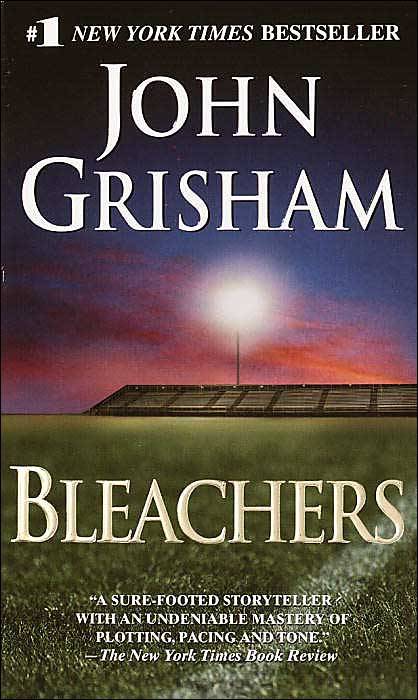
Book Review: Bleachers by John Grisham


John Grisham has written books outside his field of legal thrillers before. The first one I read in 2011 was “Skipping Christmas” which they adapted into a movie some years back. I wasn’t very pleased with the story and came away thinking Grisham should stick to novels like “Runaway Jury” or “Innocent Man”. But Grisham isn’t a bad writer himself and I had a copy of “Bleachers” on my shelf from an impulse purchase at a second-hand store, so I committed myself to engaging his tiny novella. Unlike “Skipping Christmas”, Grisham explores much more personal themes concerning forgiveness, the measure of greatness, the unfairness of life, and finality of our choices.

Eddie Rake, the dying coach, for whom many of his former players return to their hometown to pay their respects, was something of a hard ass. They all hate Coach Rake at some point, but come to grudgingly respect him for all he has taught them. One of his players, Neely Creenshaw, harbours a secret about a violent altercation between the coach and himself. After that fight, Neely has been bitter and distant, and the vigil he gives his coach is also a vigil for the man he used to be, and the man he could have become. Grisham works to deconstruct the legend that is Eddie Rake through the collective experiences of his players. Rake’s reputation of greatness is undisputed, but like everyone else, he is just a flawed human being prone to the same mistakes. The vigil his players hold for him illustrate that despite his cruel regimes, gruff exterior, and rough countenance, he has a man who loved his players but couldn’t show it; adored his family, but dominated them, and loved to triumph, but couldn’t fathom defeat.

Neely spends fifteen years drifting through life in bitter stupor after he suffers a knee injury that ends professional football career. His wife leaves him after two miscarriages. But the shadow that hangs over his life is the confrontation with Coach Rake in the locker room of their 1987 championship game. He never forgave the man until he returns to his hometown for the first time in fifteen years to sit vigil for his coach. Grisham paints a sombre man lost in his reverie, longing for the better times after having fallen on hard ones. Neely’s air is permeated with a sense of loss and grieving, both for his own soul and for his fallen coach. He is man of deep regrets, for his lost love, his game, and his coach.

Grisham tells us that we can’t reclaim the past. When Neely meets his former girlfriend and apologizes for the way he treated her, there is almost a moment when the reader can see how desperately Neely hopes to venture back into the past. But soon after that point, reality steps in and we see just how much their lives have diverged. Not all rifts can mend. We can’t go back into the past, but what this story illustrates is the hope of letting go of it and moving forward.

Saturday, 9 March 2013

Day 38: The War of the Worlds by HG Wells

For a Victorian era piece, Wells astonished me by the level of gritty, gruesome realism he portrays ravishing England in this powerful novella about extra-terrestrial invaders from Mars. You might have seen the Tom Cruise version set in modern times or you might even have some knowledge of the radio play. But this original is just as good, as vivid, and haunting in its approach of classical weaponry against a monstrous foe they can’t even conceive of. Wells is a fantastic speculative writer with a vivid mind.
       

Tuesday, 26 February 2013

Stiff by Mary Roach

“Stiff” is a macabre, compelling, witty investigation of the postmortem. For such a small book, Roach covers a broad scope of accumulated knowledge regarding our dead-selves, its history, and purpose. She treats taboo topics with a sensitive hand and the intense, painstaking attention to detail apparent in the exposition easily lends her major authority on the topic. Mary Roach aims to shed light on the achievements and involvement of cadavers in scientific advancement. With two-thousand years of history to sift through, she manages to highlight the most significant (and most unique) examples with a deftness and awareness that is amazing.
 
Roach approaches life and death and the strange topics that most would find distasteful with a light touch and a humorous voice. Her little sidebar footnotes are terrific and often funny to read. Throughout the book, she sprinkles her opinions and confusions and own ideas, giving the prose a distinctly living taste. But never is Roach disrespectful to the cadavers or those who donate their bodies, which I think is an important factor that makes this book popular.

I love reading nonfiction literature. It is a breadth of knowledge that is as valuable to human imagination as great fiction. I was skeptical when I first decided to open “Stiff.” A book about cadavers isn’t my regular cup of tea, but I’ve come to realize that what we need is to step out of our comfort zones once and a while. I think we’d all be a little mildly, delightfully surprised at what find. For example, I pleasantly learned that cadavers had a hand in testing the authenticity of the Shroud of Turin, in France’s first guillotines, heart transplants, solving the mystery of the TWA Flight 800, and the first blood transfusions. In their silent, unassuming, and unpretentious way, cadavers have been working to make life better for those left behind.

Tuesday, 19 February 2013

Book Review: Foundation by Isaac Asimov

imageIt is astonishing to realize that science fiction consisted of a relative humble portion of Isaac Asimov’s ouevre. While most of his time was spent on nonfiction work, his contributions to science fiction proved so monumental that there is not a single science-fiction writer today who has not been influenced, in some way, by Asimov’s writing. His intellectual and engaging fiction has produced some of the finest short stories and novels in the genre, in classics such as “The Last Question” and “Nightfall”. But his seminal work is the top-of-the-pyramid, groundbreaking, and famous “Foundation Trilogy”. He is to SF what Tolkien is for Fantasy.

“Foundation” is an entertaining piece of sociopolitical SF in the backdrop of a space opera. This book is the foundation of SF for the past six decades. Asimov’s prose is clear and concise, without any room for ambiguity or vain style. Asimov’s words, though pared down and stripped of subtext, are not any less true or beautiful or witty.

Set thousands of years in the future, after humanity has colonized millions of planets in our galaxy, “Foundation” introduces the Galactic Empire is in its waning years. One man on the capital planet of Trantor, Hari Seldon, predicts the cataclysmic and chaotic decline and fall of the Empire. Seldon has developed the science of psychohistory, which aims to calculate the behaviour of mass populations over the course of events using, among other things, socioeconomic trends. Seldon has predetermined not only the demise of the Empire, but that thirty millennia of barbarism will follow, unless his organization, the Foundation, is able to finish its gargantuan mission of cataloguing and preserving all accumulated human knowledge and history. The act would serve to lessen an inevitable thirty-thousand years to a mere thousand.

Asimov portrays the epic grandeur of the galaxy through the unyielding arc of time and history. Individual lives are ineffectual, though not inconsequential, in the grand scheme of things.  Throughout the stories, there is a pervading sense of ‘greater good’ or ‘the bigger picture’. There is only one recurring character in each of the five tales: the Foundation. It stands in the background, an entity both mysterious and arresting; a godlike presence that shaped religion and ruled a city. The story of the Foundation is portrayed through the periodic snippets of human life throughout the growth of the First Foundation from an indefensible, dependent, colony in the backwaters of the outskirts of a great empire to a massive political juggernaut with commercial and technological prowess. The central characters: Hari Seldon, Gaal Dornick, Salvor Hardin, Linmar Ponyets, and Hober Mallow are seen in flashes as their importance and contribution to the longevity of the Foundation is waxes and wanes.Asimov has an arresting flair for conjuring up a methodical, articulate, and complex history. In the battle for free will over determinism, Asimov’s “Foundation” falls securely into the side of the determinists. Psychology and economic trends and the insurmountable turn of time dominate the short stories with a sense of inevitability. But it the tone of the story is far from pessimistic. There is only ever the slightest indication that they should lose hope, or that individual lives are meaningless. As one character says, “Seldon’s laws help those who help themselves.” Asimov appears to advocate forging a better future through the sole and collective action of the present.Unquestionably, “Foundation” is an intellectual treat that tends to emphasis the background scenes as opposed to the ones that illustrate more action. Most of the book is exposition and dialogues between characters in a meeting over smokes. The third story, The Mayors, provides the most exciting, and arguably cleverest, climactic confrontation in the book. It is a scene between Mayor Hardin and Prince Regent Wienis. Hardin, in a stroke of brilliance, has manipulated events to stave off a rival political party’s attempt to impeach him and end the threat posed by the Four Kingdoms.“Foundation” is a significant to the genre in more ways than the ideas it challenged us with. It is the culmination of science fiction into a literature encompassing reason and ideas. It reinvigorated the genre and turned it into a platform of higher ideals and concepts. “Foundation” steered it away from the pulp swamp creatures. It did for science fiction what “Spiderman” (2002) did for superhero movies, or in particular, what Christopher Nolan’s “Batman Begins” (2005) reboot did for the franchise. Asimov gives us excellent characters, complex sociopolitics, and a good story that never wanes.

Book Review: When Patty Went to College by Jean Webster

                                                
Jean Webster published her first novel, “When Patty Went to College” in 1903. Like her uncontestably more famous “Daddy Long Legs” (1912), her debut novel was based on her life and experiences in a women’s college. The book is a collection of loosely connecting stories about Patty Wyatt’s senior year, beginning with her first day in her new dorm and ending a few weeks before graduation. As “Daddy Long Legs” introduced me to Jean Webster’s body of writing, I admit it was rather difficult not to draw comparisons between the two novels, and particularly, between Judy Abbott and Patty Wyatt.

Patty Wyatt could have been a politician had she been born in a more modern time. She can be described as charismatic and imperturbable, carefree and creative, lazy and intelligent, fun-loving and reckless. Throughout the book, in spite of Patty’s misadventures, clever antics, and pranks on her fellow classmates to entertain herself, she is well liked by her friends and faculty. As Cathy Fair tells her in the denouement to the final story, “I’ve always liked you, Patty,—everybody does,—but I don’t believe I’ve ever appreciated you, and I’m glad to find it out before we leave college.” She can be a trifle judgmental, cuts church, and can hardly be moved to study more than she absolutely has to, and yet, whenever Patty is confronted between the right choice and the easy way out, she displays a strong sense of morality and honesty in spite of the consequences. I like her character. Patty is easygoing and yet proactive; you just know that if she were the recipient of an anonymous benefactor to study at college, she wouldn’t be inclined to send monthly letters to her mysterious figure. No, Patty Wyatt would have tracked him down and pulled aside the curtains to reveal Jervis Pendelton before her first letter even arrived in his mailbox. Judy’s story is one sprawling adventure spread over her collection of chronicling letters; Patty’s story is a collection of all these tiny adventures that compose one book. I wonder if she drank coffee.

The book lacked cohesion in its narrative. Each story was a snapshot of life from the beginning to end of her last year in college and yet I couldn’t help but feel like it was missing a unifying theme or oscillating purpose. Some of the stories concentrated on Patty’s dilemmas involving owning up to her faults and confessing; these pieces connected in their purpose of showing Patty’s gradual maturity.

In context, the relatively heavy-handed moralizing in some of Patty’s tales is to be expected. This was a novel written in the early 20th century for children and adolescents. It could have been far worst. Traces of Webster’s first-wave feminism shine through and are as strong as they are in her later writing. She explores contemporary issues such as women’s rights, women’s education, socialism, and gender roles with an air of a bygone era’s lightheartedness. On the whole, I would classify this as lighter than “Daddy” or “Dear Enemy,” which I find to be Webster’s most serious endeavor. I liked this novel on its own merit. The glimpse into life of a bygone time and place, into the world that Jean Webster occupied for years, was worth the read.

Day 31: The Art of War by Sun Tzu

This ancient and informative text is as essential to classical warfare as it is to modern business. Sun Tzu’s great textbook is a series of profound advice. Their greatest asset is how applicable and malleable his rules and advice are given the context and circumstance. It is a truly captivating work and a look into the minds that dominated the craft of war.

Day 29: Animal Farm by George Orwell

A political satire that every high school student must have studied in their English class. I must have been one of the few that actually enjoyed this vital work of contemporary culture. George Orwell’s classic work is an allegory and satire of the Russian Revolution, a biased and yet informative paradigm that illustrates how boundless hope and potential can disintegrate into tyranny. The bold struggle of the animals against the oppression of Mr. Jones in his Farm forges the Animal Farm, founded on the notion that All Animals Are Created Equal. But when the pigs re-establish an elite class over the masses, betraying their faithful followers, all realise the dark significance of the tacked-on postscript that Some Animals Are More Equal than Others. If you didn’t study this phenomenal work in high school, it’s never too late to read it now.

Tuesday, 4 September 2012

Day 8: Neuromancer by William Gibson

Gibson’s debut novel is a revolutionary work that epitomizes futuristic science fiction. His vision of the future is more vivid, gritty, and realized than cinematic Star Wars. “Neuromancer” is the winner of the Hugo, Nebula, and Philip K. Dick Awards. It absolutely permeated the collective consciousness of western culture in such a seamless manner that we don’t even know the origins were from here. Interesting side note, a porn star in the 90s, created a porn parody of “Neuromancer.” Just saying…

Monday, 3 September 2012

Book Review: The Girl with the Dragon Tattoo by Stieg Larsson

This is a terrific and terrifying tour-de-force in the vast plains of culture, mystery, and journalism. Larsson’s first novel in the Millennium Trilogy is a stunning tale of an age-old mystery and an investigation into the bowels of corruption and intrigue that permeate a wealthy Swedish family. I found the novel slow to get rolling. It takes such a considerable amount of time for the characters to move along that I’m reminded of how it feels to wake up in the morning: the long lethargic stretch, followed by a pause, and then a slow staggering out of the bedroom. I won’t spoil any details, except to say that financial journalist Mikael Blomkvist is convinced to take on a job by Henrik Vanger to ghostwrite his autobiography and solve the locked-room on an island mystery of the disappearance of his niece, Harriet Vanger in the sixties. He is teamed up with the antisocial, problematic, and unquestionably brilliant hacker Lisbeth Salander, the girl with the dragon tattoo.
                                 
I don’t know how much time Larsson spent developing the central mystery that envelops the life of Henrik Vanger, an obsession that totally eclipses everything else, but it is an intriguing one and tasteful in its execution. For Henrik, Harriet is dead, even if her body was never recovered, nor the method of her death proven. The questions that remain for him are: who, why, and how? Those questions are dissected in the novel through the eyes of Mikael, and later through his partner, Lisbeth. It was a treat to watch Larsson handle his characters, shaping them into realistic and distinct persons.
Larsson’s attention to detail is superb, the trait any mystery or thriller author requires. Needless to say, I was impressed by the level of detail and analysis that went into the investigation part of Harriet’s disappearance.

Like I said before, this book is somewhat slow. That is probably my only grievance, but it isn’t much of one at all. During my first read-through, it seemed to take countless pages before any real tension; any drama began to seep through the pages. In fact, Lisbeth and Mikael are on two wildly different and completely disconnected paths until quite late into the novel when Lisbeth helps tackle his case. The author also spends a lot of time giving exposition to relevant history and to a host of terminology and processes in the financial world and technology.

Though Larsson takes his time to build up the story, the suspense is gripping in the latter half of the novel. Larsson indeed breathes a potent vibrancy into his writing. Translated into English from Swedish, the prose retains some non-americanisms that ring in the ear. Just from reading aloud the dialogue and the supporting texts, the prose is decidedly euro-centric and quite refreshing. Most of the novels I’ve consumed are North American or English, and though I’m quite new to the game of Scandinavian thrillers, I have to say I like what I’ve read so far.

Thursday, 1 March 2012

Day 4: Fahrenheit 451 by Ray Bradbury

You’ve probably read this already. If you haven’t, get out from under that damn rock, and check it out. It’s popular in many high school English curriculums. Unfortunately I was never made to read it in any of my classes. That sucked balls. Eventually I got around to it sometime in college and was exhilarated by his imaginative, energetic prose. The characters are dynamic and unforgettable. The story of a book-burning dystopian future highlights a bleak, tragic flaw in human nature. We choose to forget, we choose ignorance over truths; instant gratifications over meaning. Although published almost sixty years ago, this book is still widely relevant in our culture in the 21st century.

In 1966, François Truffaut wrote and directed a film adaptation of the Fahrenheit 451 and two very closely adapted BBC Radio 4 dramatizations have aired since the book's publication in 1953. Also, I recently found signed Easton Press copies of this book on eBay. Once I have hundreds of dollars lying around, I know what I'm getting.